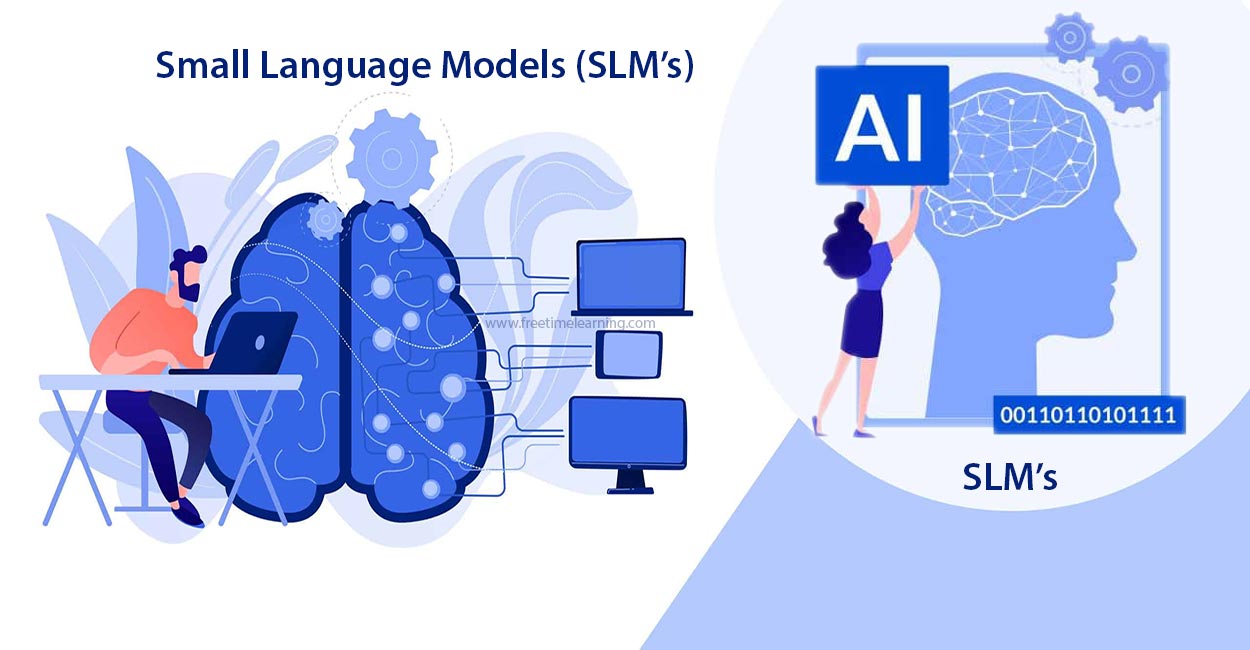
While large language models (LLMs) like GPT-4 and Gemini dominate AI discussions, small language models (SLMs) are emerging as a powerful, efficient, and specialized alternative. By 2025, SLMs will play a crucial role in edge computing, privacy-conscious AI, cost-effective deployments, and domain-specific applications.
SLMs are AI models with fewer parameters (typically under 10 billion parameters) that require significantly less computational power compared to large-scale LLMs. They are optimized for speed, efficiency, and deployment on low-resource devices such as smartphones, IoT devices, and embedded systems.
| Feature | Small Language Models (SLMs) | Large Language Models (LLMs) |
|---|---|---|
| Model Size | < 10B parameters | 100B+ parameters |
| Computational Cost | Low | High |
| Inference Speed | Fast | Slower |
| Hardware Needs | Runs on CPUs, mobile, edge | Requires GPUs, TPUs |
| Use Case | On-device AI, specialized apps | General-purpose, cloud-based AI |
Popular SLMs include Mistral 7B, Llama 2 (7B), Falcon 7B, and GPT-2.
SLMs will drive edge AI by running directly on local devices (smartphones, smart home assistants, autonomous vehicles, and industrial IoT).
Benefits :
* Reduces reliance on cloud computing
* Improves response time (low-latency AI)
* Enhances privacy (no data sent to the cloud)
Examples :
With increasing concerns over data privacy, local AI processing using SLMs will become the preferred choice for many industries.
* Why Privacy Matters?
* Examples:
Running LLMs in the cloud is expensive ?. Many businesses will adopt SLMs as a cost-effective alternative for specialized tasks.
Advantages of SLMs in Enterprises :
* Can be fine-tuned for industry-specific tasks
* Reduce cloud dependency → Lower operational costs
* Run on standard hardware (no need for expensive GPUs)
* Example Use Cases:
SLMs can be fine-tuned for specific industries rather than relying on general-purpose LLMs.
Industry Applications :
* Healthcare – AI that analyzes patient data on local devices
* Finance – Risk analysis and fraud detection with lightweight AI
* Manufacturing – AI-driven predictive maintenance for factories
* Education – AI tutors that run offline for students
Example : A legal SLM trained on legal jargon and case laws can be faster and more accurate than a general LLM for lawyers.
SLMs will power personalized AI applications that adapt to individual users without sending data to the cloud.
Examples :
* Personal AI assistants that learn user preferences locally
* AI-powered note-taking apps that summarize personal content
* Smart home automation that learns habits without exposing data
Future Scenario : Imagine a fully private AI assistant running on your phone, learning from your texts, emails, and calendar without ever sending data to the cloud.
* Limited knowledge compared to LLMs → Requires frequent updates
* Lower generalization ability → Better suited for domain-specific tasks
* Fine-tuning complexity → Requires expertise to adapt to specific needs
By 2025, expect :
* Hybrid AI models – Combining SLMs for local tasks & LLMs for cloud-based tasks
* More open-source SLMs – Growth of efficient, specialized AI
* Widespread adoption in AI chips – AI-powered devices using local processing
Small language models (SLMs) offer a lightweight, efficient alternative to large-scale AI models. While they come with several benefits, they also have limitations. Let's explore both sides.
* Require less processing power and memory
* Can run on CPUs, edge devices, and mobile hardware
* No need for expensive GPUs or cloud infrastructure
Example: An AI-powered note-taking app that runs locally on a smartphone instead of needing a cloud connection.
* Lower latency due to fewer parameters
Use SLMs when :
* Efficiency, speed, and privacy are top priorities
* Running AI on edge devices or low-power hardware
* Need cost-effective, fine-tuned AI for a specific task
Avoid SLMs when :
* Deep knowledge, complex reasoning, or multi-tasking is required
* Need highly fluent, human-like text generation
* Handling large-scale, multilingual, or open-ended queries
Future Outlook: As SLMs continue to improve, they will become a dominant force in on-device AI, industry-specific applications, and privacy-conscious solutions.