Advantages and Disadvantages of Artificial Intelligence

Last Updated : 03/02/2025 12:45:57

Artificial Intelligence refers to the development of computer systems that can perform tasks typically requiring human intelligence.

Advantages and Disadvantages of Artificial Intelligence


What Is Artificial Intelligence?


Artificial Intelligence refers to the development of computer systems that can perform tasks typically requiring human intelligence. These tasks include learning from experience (machine learning), reasoning, problem-solving, understanding natural language, recognizing images or speech, and making decisions. AI can range from narrow systems—like a spam filter or a chess-playing program—to theoretical general AI, which would match or exceed human cognitive abilities across diverse domains. At its core, AI is about mimicking or enhancing human-like capabilities through algorithms, data, and computational power.

Now, building on that, here are the advantages and disadvantages :


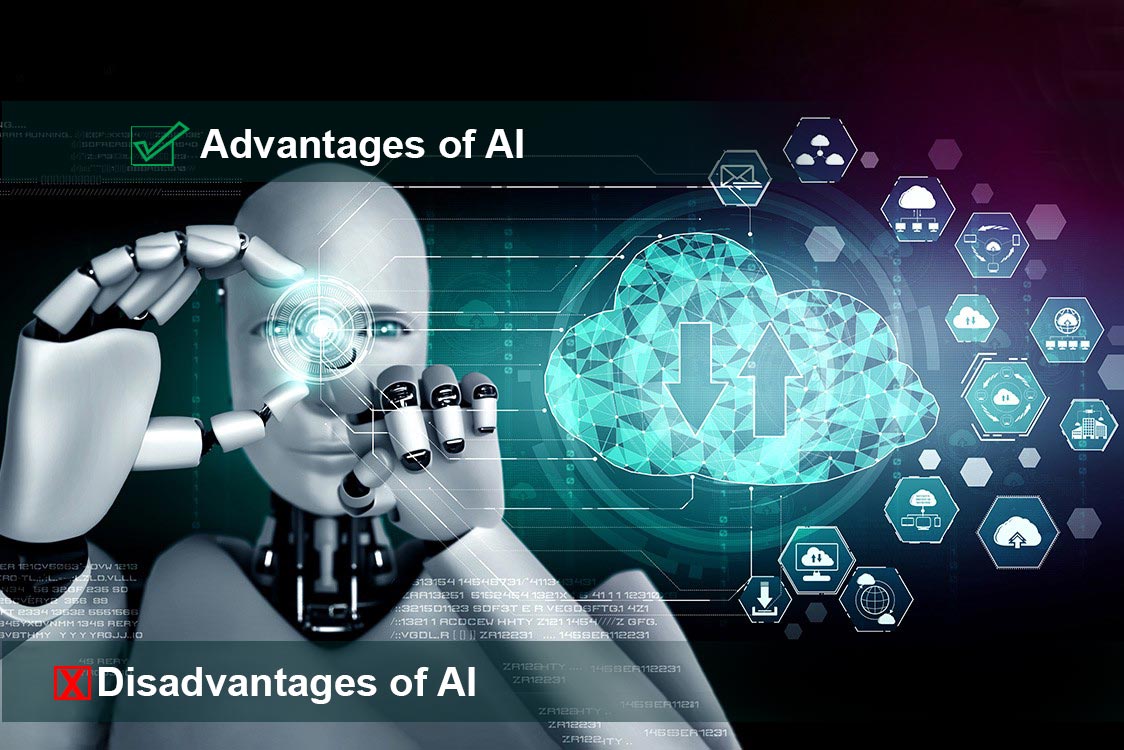
Advantages of Artificial Intelligence :


1. Efficiency and Automation :
* AI can automate repetitive tasks, reducing human effort and increasing productivity.

* It operates 24/7 without fatigue, ensuring consistent performance.

2. Accuracy and Precision :
* AI systems can perform tasks with high accuracy, minimizing errors in areas like data analysis, medical diagnoses, and manufacturing.

3. Data Analysis and Insights :
* AI can process and analyze vast amounts of data quickly, identifying patterns and trends that humans might miss.

* This is particularly useful in fields like finance, healthcare, and marketing.

4. Cost Savings :
* By automating tasks and improving efficiency, AI can reduce operational costs over time.
* It minimizes the need for manual labor in certain industries.

5. Innovation and Problem-Solving :
* AI enables the development of new technologies and solutions, such as self-driving cars, personalized medicine, and advanced robotics.

* It can tackle complex problems that are beyond human capability.

6. Improved Customer Experience :
* AI-powered chatbots and virtual assistants provide instant, personalized support to customers.

* Recommendation systems (e.g., Netflix, Amazon) enhance user experience by suggesting relevant products or content.

7. Enhanced Decision-Making :
* AI systems can analyze data and provide insights to support better decision-making in business, healthcare, and other fields.

8. Safety and Risk Reduction :
* AI can be used in hazardous environments (e.g., disaster response, mining) to reduce risks to human life.

* It can also improve safety in transportation (e.g., autonomous vehicles).


Disadvantages of Artificial Intelligence :


1. High Costs :
* Developing and implementing AI systems can be expensive due to the need for advanced hardware, software, and skilled professionals.

2. Job Displacement :
* Automation through AI may lead to job losses in certain sectors, particularly for repetitive or low-skilled tasks.

* This can contribute to economic inequality and social unrest.

3. Lack of Creativity and Emotional Intelligence :
* AI lacks human-like creativity, intuition, and emotional understanding, which are essential in fields like art, counseling, and leadership.

4. Bias and Discrimination :
* AI systems can inherit biases from the data they are trained on, leading to unfair or discriminatory outcomes.

* This is a significant concern in areas like hiring, law enforcement, and lending.
5. Dependence on Data :
* AI relies heavily on large datasets for training. Poor-quality or incomplete data can lead to inaccurate or unreliable results.

6. Security and Privacy Concerns :
* AI systems can be vulnerable to hacking and misuse, posing risks to data privacy and security.

* The collection and use of personal data by AI raise ethical concerns.

7. Ethical and Moral Issues :
* The use of AI in areas like surveillance, warfare, and decision-making raises ethical questions about accountability and transparency.

* There is a risk of AI being used for malicious purposes.

9. Over-Reliance on Technology :
* Excessive dependence on AI systems may reduce human critical thinking and problem-solving skills.

* Malfunctions or errors in AI systems can have severe consequences if humans are not prepared to intervene.

10. Environmental Impact :
* Training large AI models requires significant computational power, which can contribute to high energy consumption and carbon emissions.


Conclusion :

AI offers tremendous potential to revolutionize industries, improve efficiency, and solve complex problems. However, it also comes with challenges such as ethical concerns, job displacement, and bias. To maximize the benefits of AI while minimizing its drawbacks, it is essen

Note : This article is only for students, for the purpose of enhancing their knowledge. This article is collected from several websites, the copyrights of this article also belong to those websites like : Newscientist, Techgig, simplilearn, scitechdaily, TechCrunch, TheVerge etc,.