
| Student | Mathematics | Physics | Chemistry |
|---|---|---|---|
| Student # 1 | 89 | 77 | 84 |
| Student # 2 | 98 | 89 | 80 |
| Student # 3 | 75 | 70 | 80 |
| Student # 4 | 60 | 75 | 80 |
| Student # 5 | 84 | 80 | 75 |
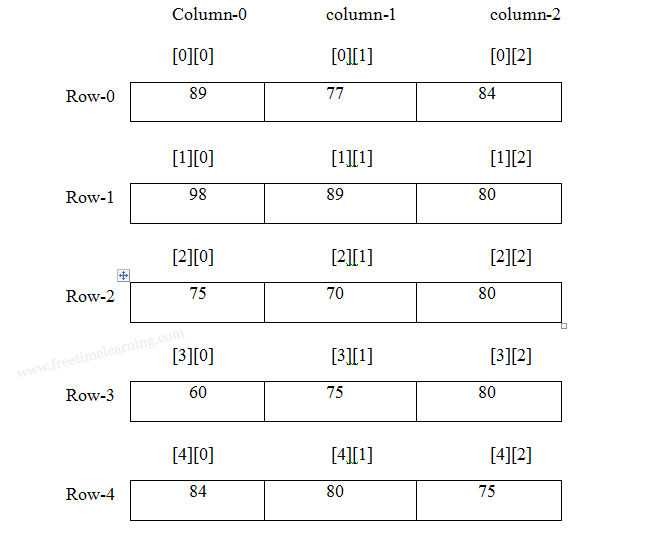
• The above table contains a total of 15 values.
• We can think this table as a matrix consisting of 5 rows & 3 columns.
• Each row represents marks of student # 1 in all (different) subjects.
• Each column represents the subject wise marks of all students.
• In mathematics we represent a particular value in a matrix by using two subscripts such as Vij. Here V denotes the entire matrix Vij refers to the value in “ i ”th row and “ j ”th column.
Example :
In the above table V23 refers to the value “80”.
C allows us to define such tables of items by using two-dimensional arrays.
Definition :
A list of items can be given one variable name using two subscripts and such a variable is called a two – subscripted variable or a two – dimensional array.
Two – Dimensional arrays can be declared as.
The above table can be defined in “C” as
The above table can be defined in “C” as
Representation of a two Dimensional array in memory :
Initializing Two- Dimensional Arrays :
• Like the one-dimensional arrays, two-dimensional arrays may be initialized by following their declaration with a list of initial values enclosed in braces.
int table[2] [3] = {0,0,0,1,1,1};
• This initializes the elements of first row to zero and the second row to one.
• This initialization is done row by row.
• The above statement can be equivalently written as
int table[2][3] ={{0,0,0},{1,1,1}};
• we can also initialize a two-dimensional array in the form of a matrix as shown.
int table[2][3] = {
{0,0,0},
{1,1,1}
};
• Commas are required after each brace that closes of a row, except in case of last row.
• If the values are missing in an initialize, they are automatically set to zero.
Ex: int table [2] [3] = {
{1,1}, 1 1 0
{2} 2 0 0
};
 # include<stdio.h>
 # include<conio.h>
 main( ) {
         int  i,j;
         int  a[3][3] = { { 1,2,3}, {4,5,6}, {7,8,9}};
         printf(“elements of an array \n \n”);
         for( i=0; i<3; i++)  {
              for ( j=0; j<3; j++){
                       printf (“%d\t”, a[ i ][ j ]);
              }  printf(“\n”);
           }
getch();
 }
Elements of an Array
1 2 3
4 5 6
7 8 9
# include<stdio.h>
  # include<conio.h>
  main( )
   {
  int i,j,r1,c1, a[10][10], b[10][10];
  clrscr( );
  printf(“Enter Order of Matrix A & B up to 10 x 10:”);
  scanf(“%d  %d”, &r1, &c1);
  printf(“Enter Elements of Matrix of A: \n”);
  for( i=0; i<r1; i++)
  {
       for( j=0; j<c1; j++)
       scanf(“ %d ”, &a[ i ][ j ]);
  }
  printf(“Enter Elements of Matrix of B: \ n”);
  for( i=0; i<r1; i++)
    {
      for( j=0; j<c1; j++)
     scanf(“ %d ”, &b[ i ][ j ]);
    }
  printf(“\n Matrix Addition \n”);
  for( i=0; i<r1; i++)
    {
      for( j=0; j<c1; j++)
       printf(“%d\t”, a[ i ][ j ] + b[ i ][ j ]);
       printf (“ \n”);
    }
  printf(“n Matrix Subtraction \n”);
  for( i=0; i<r1; i++)
    {
      for( j=0; j<c1; j++)
      printf(“%d\t”, a[ i ][ j ] – b[ i ][ j ]);
      printf(“\n”);
    }
  getch( );
    }
Enter order of Matrix A & B up to 10 x 10: 3 3
Enter Elements of Matrix of A :
4 5 8 2 9 8 2 9 4
Enter Elements of Matrix of B :
1 3 5 0 5 4 6 7 2
Matrix Addition
5 8 13
2 14 12
8 16 6
Matrix Subtraction
3 2 3
2 4 4
-4 2 2